
Business
Large Cap vs Multicap Funds – Stability or Diversified Growth?

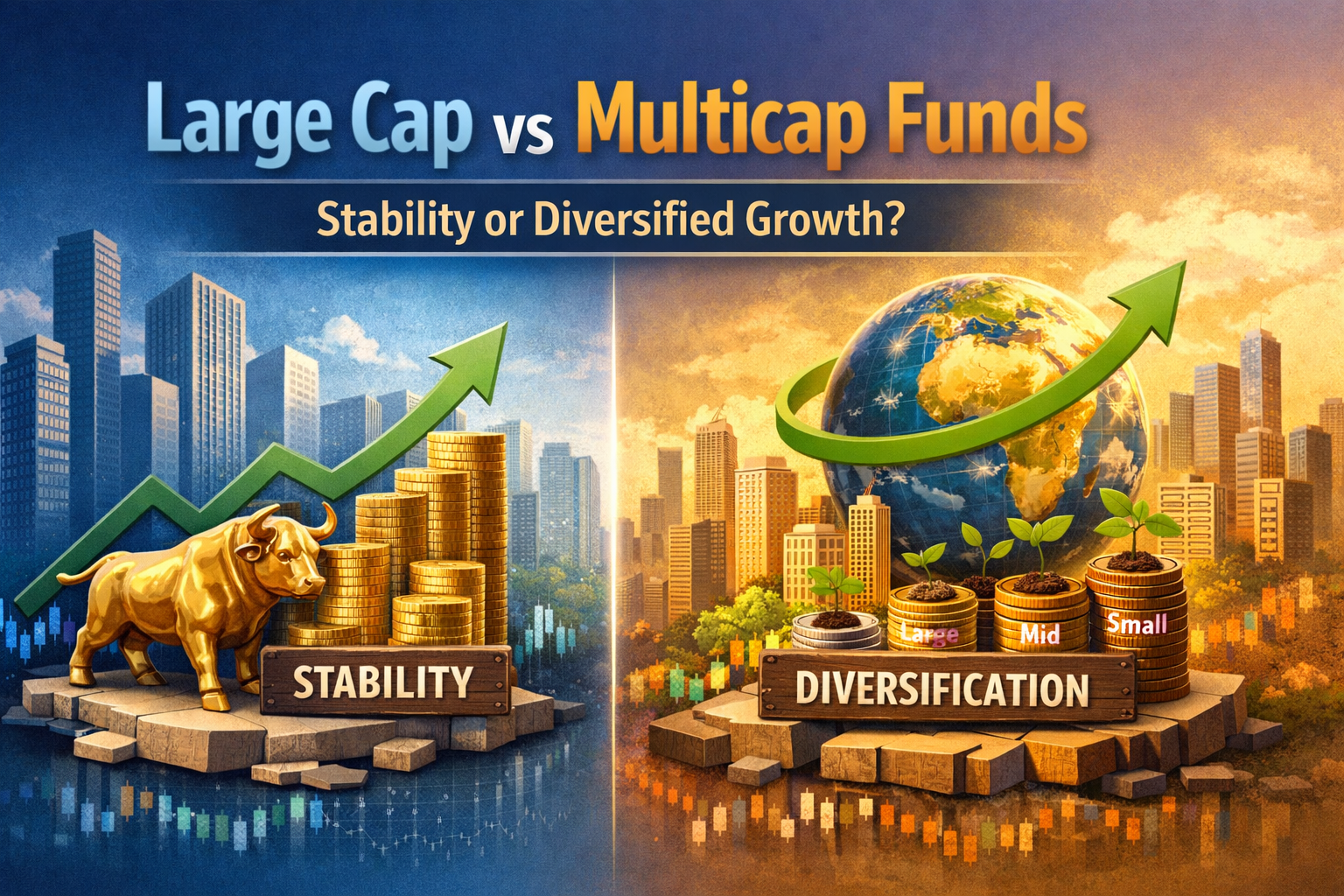
When comparing equity mutual fund categories, investors often evaluate large cap vs multicap funds to understand which option better aligns with their financial goals and risk appetite. Although both categories invest in equities, they differ in allocation structure, diversification level and exposure across market capitalisations. Large cap funds primarily invest in established companies with relatively stable earnings visibility, while multicap funds provide mandatory diversification across large, mid and small cap stocks. These structural differences influence volatility, growth participation and portfolio roles.
A clear understanding of large cap vs multicap funds helps investors evaluate which category better fits their financial goals, risk tolerance and long term asset allocation.
Key Takeaways
- Large cap funds invest at least 80% in top 100 companies by market capitalisation as defined by SEBI.
- Multicap funds allocate minimum 25% each to large, mid and small cap stocks.
- Large cap funds generally exhibit relatively lower volatility compared to multicap funds.
- Multicap funds offer broader market participation and diversified growth exposure.
- Market cycles influence performance differently across market capitalisations.
- Equity investments are typically suited for long term horizons (5+ years).
- The choice between large cap vs multicap funds depends on individual goals, risk appetite and portfolio needs.
What Are Large Cap Funds?
As per the classification framework defined by the Securities and Exchange Board of India (SEBI), large cap fund are equity mutual fund schemes that invest a minimum of 80% of their total assets in large cap companies.
Large cap companies refer to the top 100 listed companies in India based on market capitalisation. These businesses are typically well established organisations with relatively mature business models, stronger market presence and comparatively stable earnings visibility.
Key Features
- Minimum 80% allocation to large cap equities
- Exposure to established industry leaders
- Relatively lower volatility compared to mid and small cap segments
- Often used as core holdings within equity portfolios
Potential Benefits
- Relative stability during periods of market uncertainty
- High liquidity due to actively traded stocks
- Established corporate governance and business track records
Important Considerations
- Limited allocation to emerging or smaller high growth companies
- May lag broader markets during strong mid or small cap rallies
Large cap funds are generally considered suitable for investors seeking long term equity participation with relatively moderated volatility, subject to market risks.
What Are Multicap Funds?
Multicap fund follows a structured diversification approach. Under SEBI regulations, these schemes must invest
- Minimum 25% in large cap stocks
- Minimum 25% in mid cap stocks
- Minimum 25% in small cap stocks
This mandatory allocation framework ensures exposure across multiple segments of the equity market.
Key Features
- Balanced allocation across market capitalisations
- Diversified exposure within a single scheme
- Participation across different business growth stages
- Dynamic exposure to varying market opportunities
Potential Benefits
- Access to both established and emerging companies
- Diversification across economic cycles
- Broader market participation through one investment vehicle
Important Considerations
- Higher short term volatility compared to large cap funds
- Greater sensitivity to market corrections due to mid and small cap exposure
In the context of large cap vs multicap funds, multicap funds are generally viewed as growth oriented equity options suited for investors comfortable with market fluctuations and longer investment horizons.
Large Cap vs Multicap Funds: Comparison
| Parameter | Large Cap Funds | Multicap Funds |
| Regulatory Allocation | Minimum 80% in large caps | Minimum 25% each in large, mid & small caps |
| Market Coverage | Top 100 companies | Across market capitalisations |
| Volatility | Relatively lower | Relatively higher |
| Growth Exposure | Stable growth potential | Diversified growth potential |
| Portfolio Role | Core allocation | Diversified growth allocation |
| Suitable Investment Horizon | Long term | Long term (often longer) |
The primary distinction in large cap vs multicap funds lies in breadth of exposure and resulting volatility differences.
Stability vs Diversified Growth – How to Decide?
Choosing between these categories depends on individual investment factors such as
- Risk tolerance
- Investment horizon
- Financial goals
- Existing portfolio allocation
Large Cap Funds May Be Considered When
- Preference is for relatively stable equity exposure
- Building the foundation of an equity portfolio
- Seeking exposure to established companies
- Risk appetite is moderate
Multicap Funds May Be Considered When
- Broader diversification is desired
- Comfortable with higher interim market fluctuations
- Investment horizon is long term (typically 5 years or more)
- Seeking exposure across different growth segments
There is no universally superior option in the large cap vs multicap funds comparison. Suitability depends on individual financial objectives and investment strategy.
Performance Across Market Cycles
Different market capitalisation segments tend to perform differently across economic phases:
- During uncertain or defensive market conditions, large cap companies may demonstrate relatively stable performance trends.
- During economic expansion phases, mid and small cap companies may experience stronger growth momentum, which may benefit multicap funds.
Since predicting market cycles consistently is difficult, investment decisions are generally more effective when aligned with long term goals rather than short term market movements.
Risk Considerations
Investors evaluating large cap vs multicap funds should understand the following risks:
- Market risk affecting all equity investments
- Higher volatility associated with smaller companies
- Liquidity variations in mid and small cap stocks
- Dependence on fund manager allocation decisions
Mid and small cap stocks may experience sharper price movements due to business scale, earnings variability and liquidity factors. Investors should ensure alignment between their risk profile and the fund category selected.
Why Investment Horizon Matters
Equity mutual funds are typically suited for long term financial goals.
- A minimum investment horizon of around five years is commonly considered appropriate for equity exposure.
- Multicap funds may require a longer holding period due to exposure to mid and small cap segments.
Disciplined investing and patience play an important role in managing interim volatility.
Conclusion
The discussion around large cap vs multicap funds reflects a balance between relative stability and diversified growth exposure.
Large cap funds focus on established market leaders and may serve as a core equity allocation for investors seeking relatively stable participation in equity markets. Multicap funds, through structured diversification, provide exposure across company sizes and economic growth phases.
Rather than viewing one category as superior, investors may evaluate how each fits within a diversified portfolio aligned with long term financial objectives and risk tolerance.
FAQs
1. What is the key difference between large cap and multicap funds?
Large cap funds invest mainly in the top 100 companies by market capitalisation, while multicap funds invest across large, mid and small cap stocks in mandated proportions.
2. Are multicap funds more volatile than large cap funds?
Multicap funds may experience higher short term volatility due to exposure to mid and small cap companies, which can fluctuate more than large cap stocks.
3. Which is better for long-term investing: large cap or multicap funds?
Large cap funds may suit stability focused investors while multicap funds may appeal to those seeking diversified growth participation.
4. What investment horizon is suitable for these funds?
Equity mutual funds are generally considered suitable for long-term goals, typically five years or more.
5. Can both large cap and multicap funds be included in one portfolio?
Investors may consider holding both categories to balance stability and diversification, depending on their financial objectives.
Disclaimers
Investors may consult their Financial Advisors and/or Tax advisors before making any investment decision.
These materials are not intended for distribution to or use by any person in any jurisdiction where such distribution would be contrary to local law or regulation. The distribution of this document in certain jurisdictions may be restricted or totally prohibited and accordingly, persons who come into possession of this document are required to inform themselves about, and to observe, any such restrictions.
MUTUAL FUND INVESTMENTS ARE SUBJECT TO MARKET RISKS, READ ALL SCHEME RELATED DOCUMENTS CAREFULLY.

Understanding AI Agent Architecture: From Automation to Autonomous Intelligence

How DMCA Ignored Hosting Help Adult Content Sites?

Other Alternatives to the Bigbunny Login Casino
Web UI Design Services, Custom Web App Development, or Local Product Design: Where to Start

Type-C to C vs Type A to Type C Cable: What’s the Difference?

How Executive Search Software Selects and Manages Senior Leadership Candidates

Data Science Course in Pune with Placement Support: From Classroom Training to Your First Job

Ethical Hacking Courses in Mumbai with Placement: Institutes, Duration, Fees & Jobs 2026

Best Micro Influencer Agency Singapore: Why Micro Beats Macro for Conversion

What Makes a Crypto Exchange Top-Rated? Understanding the Ranking Criteria
Web UI Design Services, Custom Web App Development, or Local Product Design: Where to Start
How Executive Search Software Selects and Manages Senior Leadership Candidates
Other Alternatives to the Bigbunny Login Casino
Type-C to C vs Type A to Type C Cable: What’s the Difference?
How DMCA Ignored Hosting Help Adult Content Sites?
Understanding AI Agent Architecture: From Automation to Autonomous Intelligence


 Tech2 years ago
How to Use a Temporary Number for WhatsApp
- Business3 years ago
Sepatuindonesia.com | Best Online Store in Indonesia
- Social Media2 years ago
The Best Methods to Download TikTok Videos Using SnapTik
- Technology2 years ago
Top High Paying Affiliate Programs
- Tech2 years ago
Understanding thejavasea.me Leaks Aio-TLP: A Comprehensive Guide
- FOOD2 years ago
How to Identify Pure Desi Ghee? Ultimate Guidelines for Purchasing Authentic Ghee Online

 Instagram4 years ago
Free Instagram Auto Follower Without Login
- Instagram4 years ago
Free Instagram Follower Without Login