
Tech
How Executive Search Software Selects and Manages Senior Leadership Candidates

Finding senior executives is fundamentally different from filling entry-level or mid-tier positions. When a company needs a new Chief Executive Officer, Chief Financial Officer, or Vice President, standard recruitment methods rarely yield results. Senior leaders are usually not scanning job boards or sending out resumes. Instead, headhunters and internal talent teams must actively identify, discreetly contact, and nurture relationships with qualified leaders who may currently be employed elsewhere.
To manage this high-stakes process effectively, organizations rely heavily on specialized executive search software. Generic applicant tracking systems (ATS) often fall short because they are built for high-volume hiring, not long-term relationship management. Specialized technology provides the precise structure, privacy controls, and data management required to source and hire top-tier leadership talent. This article covers how executive sourcing differs from standard recruiting, what separates executive search technology from ATS software, the functionality that matters in a C-suite search platform, how to evaluate headhunting software, and where the category is heading.

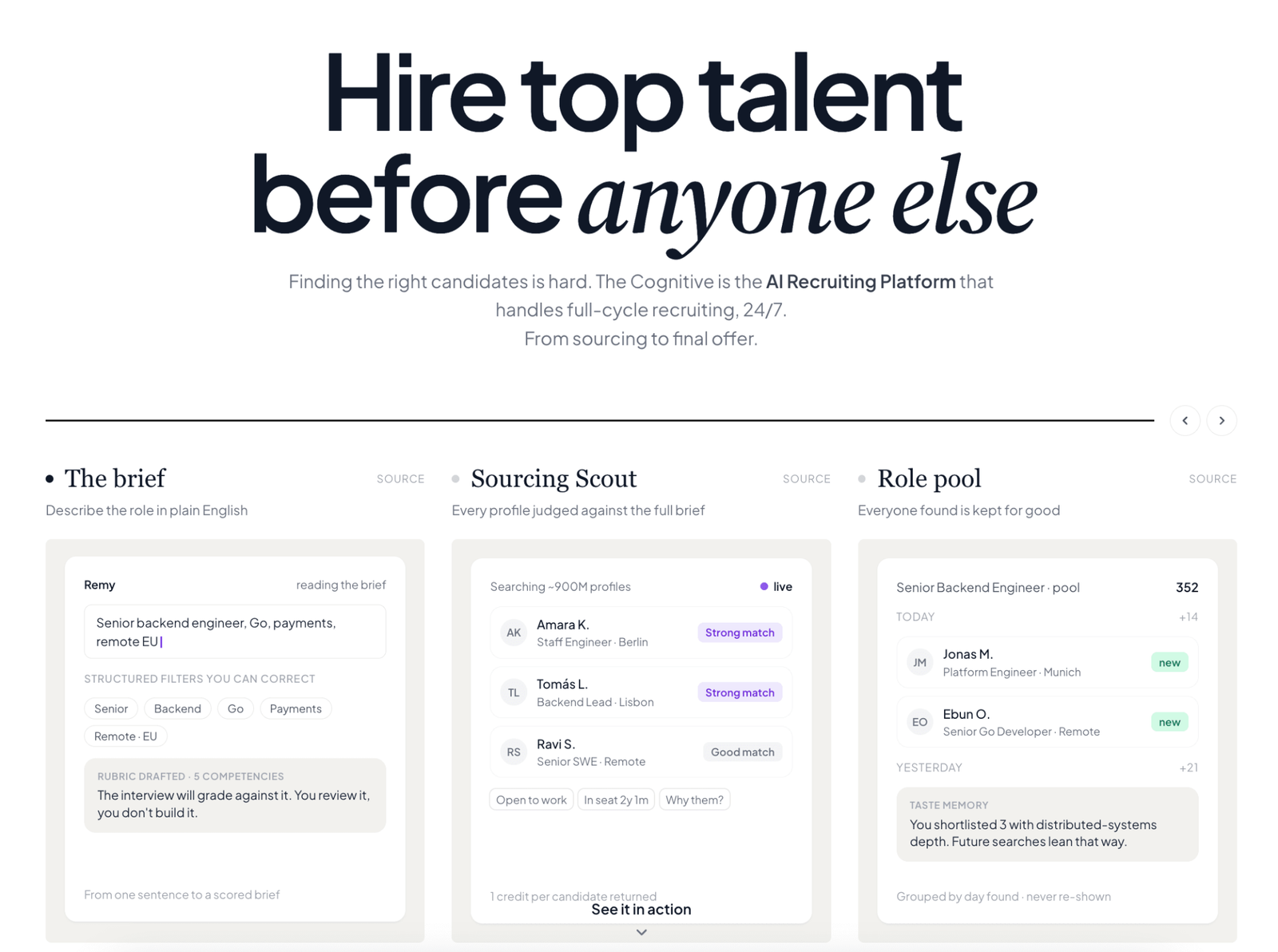
The sourcing search for a senior mandate: a one-line brief, with the title recognised before any filter is set.
The Foundations of Specialized Executive Sourcing
Traditional recruitment tools focus on handling hundreds of incoming applications per job posting. Executive recruitment, however, works in reverse. Instead of receiving dozens of incoming resumes, executive recruiters begin with zero candidates and systematically chart industries to locate potential matches. This requires an advanced executive recruiting platform designed specifically for executive sourcing and market mapping, and it is the first thing to look for in any executive search software.
In practice that research pass is candidate sourcing at its most demanding. A sourcer working a VP Engineering mandate is not searching for a title. They are looking for someone who has scaled an engineering organization through a specific stage, in a comparable industry, under comparable constraints, and who is plausibly open to a move. Keyword search on a professional network cannot express that. An AI sourcing tool built for it parses a one-line brief into typed filters about the person (title, past titles, seniority, skills, location) and about their company (industry, headquarters, size signals, and the technologies the employer runs), applies only the must-haves as hard gates, and then reads each surviving profile against the full brief to explain why it fits, what is missing, and what the data cannot answer. That last part matters more at the executive level than anywhere else, because a wrong assumption about a senior candidate is expensive to discover in a final-round conversation.
Executive hiring teams need tools that support long-standing relationships. A potential candidate contacted today might not be ready for a position for 2 or 3 years. Tracking these interactions over long periods is critical. An executive recruitment CRM allows teams to maintain detailed records of candidate interactions, personal notes, compensation expectations, and career goals over extended periods.
When working with high-level candidates, discreet communication is critical. Standard recruiting tools might accidentally send automatic email notifications or expose candidate names to non-essential personnel. Dedicated tools make sure candidate profiles remain strictly private until the appropriate stage of the interview process. A sourcing engine that keeps identities masked in search results until the recruiter chooses to reveal a contact is the same principle applied one step earlier: nobody on the team sees a name they do not need.
Key Distinctions Between ATS and Dedicated Executive Tools
Many talent leaders wonder why standard applicant tracking systems are insufficient for executive placement. The answer lies in the fundamental difference in recruitment workflows.
Passive Candidate Management
Most applicants entering a standard ATS apply directly through a corporate career page or job board. Conversely, high-level leadership candidates are almost exclusively passive. An executive talent acquisition software system focuses on proactive sourcing, company mapping, and relationship nurturing rather than receiving incoming applications. Passive candidate sourcing at this level also means reading signals an application would never carry: tenure pattern, the stage a company was at when the person joined and left, and a publicly declared openness to a move where one exists.
Complex Stakeholder Engagement
In executive hiring, decision-making involves executive boards, hiring committees, investor representatives, and founders. Information needs to be shared selectively and professionally. Specialized software allows search teams to build customized, branded reports and secure candidate portals. These portals present relevant executive bios, assessment scores, and interview feedback without giving external reviewers full system access.
Extended Hiring Timelines
While standard requisitions might aim to close within 30 days, executive searches frequently extend over several months. Managing long recruitment cycles demands robust project management capability. Search teams must track market research, industry benchmarks, referral networks, and multi-tier interviews across extended timelines without losing momentum or context.
Critical Functionalities in Modern C-Suite Search Platforms
Selecting the right technology stack requires looking closely at key features that simplify everyday operations for search firms and internal corporate search groups. The features below are what separate executive search software from general hiring software with a senior-roles label on it.
Advanced Talent Mapping and Pipeline Building
Talent mapping involves researching competitor organizational structures to pinpoint high-performing executives. Quality platforms offer built-in talent mapping tools, allowing users to visualize corporate hierarchies and chart candidate talent pipelines. This functionality makes it easier to track target companies, organizational movements, and potential successors.
Done by hand, a market map for one mandate takes a researcher weeks: list the target companies, identify who holds the role at each, estimate level and tenure, note who has recently moved. This is the research pass most executive search software still leaves to the team. An AI sourcing engine can produce the first draft of that map from the brief itself, filtering on current and previous employer, industry and headquarters, and surfacing the tenure and trajectory signals that suggest who is likely to move. The researcher then spends their time on judgement rather than on collection.
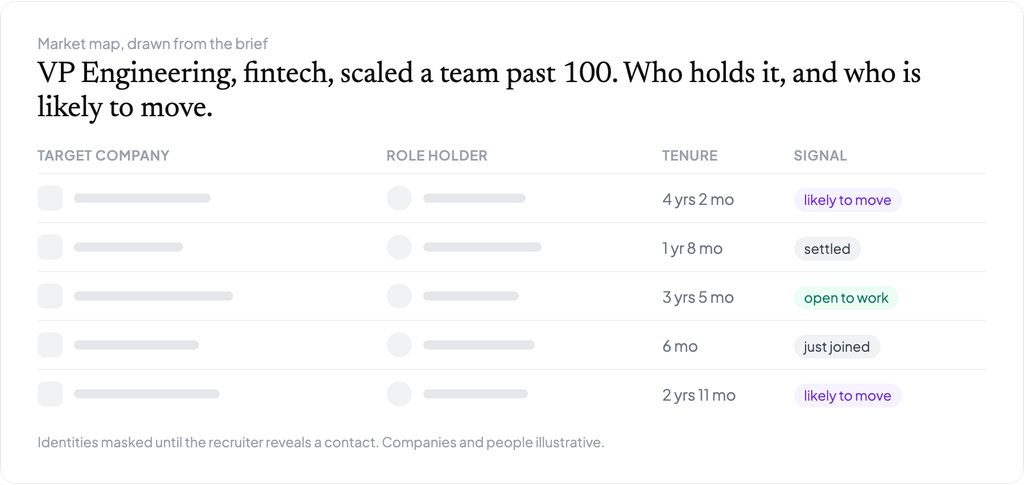
A market map for one senior mandate: target companies, the role holder at each, tenure, and a likely-to-move signal, drawn from the brief.
Secure Client and Stakeholder Portals
Transmitting executive candidate profiles over unencrypted email creates security risks and looks unprofessional. Quality software includes interactive client portals. Stakeholders can view redacted candidate documents, video interviews, and team evaluations in real time while maintaining complete data security.
Comprehensive Data Analytics and Market Insights
Understanding market availability, compensation benchmarks, and diversity metrics is vital when advising board members. High-quality C-suite recruiting tools analyze historical search data to provide clear metrics on search velocity, candidate drop-off points, and sourcing channels. These analytics help search professionals present actionable, data-driven advice during board meetings.
Evaluation That Goes Deeper Than a Resume
The stage most executive search technology leaves entirely to people is the assessment itself. Senior candidates are evaluated in long conversations, and the notes from those conversations are what the committee reads. Newer platforms add a live, two-way AI interview before the panel stage: a real conversation that follows up on each answer and returns an evidence-scored summary against the mandate’s requirements, so the committee compares candidates on the same criteria rather than on whichever interviewer wrote the most. It does not replace the partner’s judgement. It gives the partner a consistent first read on every candidate in the pool.
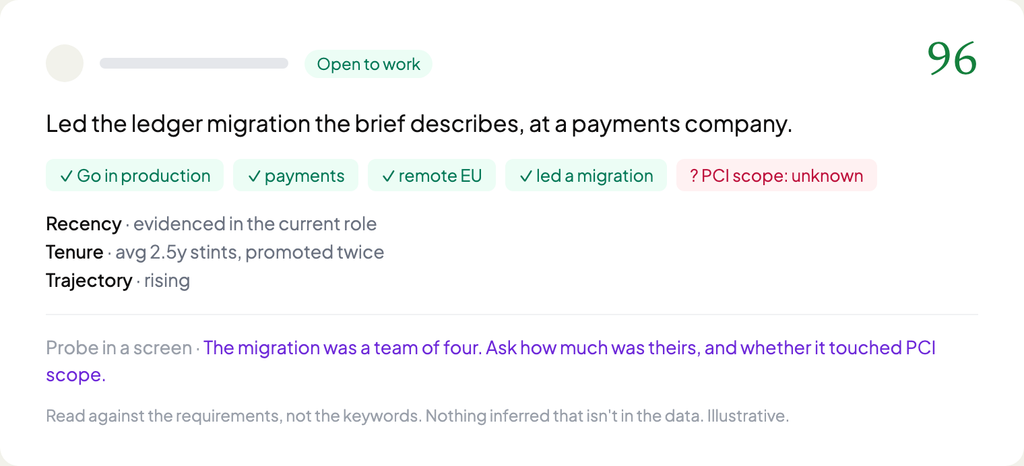
One candidate’s read: verdict, requirements met and missing, tenure, and the one thing to probe in the next conversation.
Strategic Benefits for Agencies and Internal Talent Teams
Implementing dedicated executive search software delivers measurable return on investment for both executive search firms and internal corporate search teams.
For search firms, speed and discretion are major competitive advantages. Presenting curated shortlists quickly while maintaining candidate confidentiality wins clients. An efficient system reduces administrative overhead, enabling recruiters to spend less time formatting documents and more time communicating with candidates.
For internal enterprise talent teams, bringing executive search capabilities in-house lowers reliance on external third-party agencies. Using specialized internal systems allows corporate recruiters to build long-term talent pools for executive succession planning, saving significant search fees over time.
I run The Cognitive, and the sourcing, market mapping and evaluation described above are what our platform does for senior mandates: it searches ~900M profiles from a one-line brief, keeps identities masked until a contact is revealed, runs discreet outreach in the recruiter’s name, and conducts the live two-way interview that produces the evidence-scored read. Treat that as one worked example of the category, and apply the evaluation criteria below to us as strictly as to anyone.
Evaluating Headhunting Software Solutions
Choosing software requires careful consideration of workflow, technical capability, and long-term scalability. Decision-makers should evaluate potential platforms against several core criteria.
First, examine data security and compliance features. Because executive search involves handling highly sensitive personal data, candidate compensation histories, and corporate strategy plans, compliance with global privacy regulations is mandatory. Systems must provide granular permissions, detailed audit logs, and secure encryption standards.
Second, verify integration capabilities. The software should connect seamlessly with everyday work tools, including email platforms, calendar applications, professional network databases, and video conferencing software. Seamless integrations prevent information siloing and reduce manual data entry. If the firm or the enterprise keeps an ATS or a recruiting CRM as the system of record, every sourced candidate and stage change should write back to it in both directions.
Third, assess vendor support and specialization. General recruiting software vendors often struggle to understand the nuances of executive headhunting. Working with vendor teams that specialize in executive search makes setup faster and guarantees support teams understand industry challenges. Dedicated headhunting software solutions are purpose-built to handle complex recruitment structures out of the box.
Fourth, test the sourcing on a live mandate. Give the vendor a real brief, in one line, and look at the first page of results and the explanation attached to each. If the tool cannot say why a candidate ranked, or what it does not know about them, the research pass is still yours to do.
Implementation Best Practices for Search Teams
Adopting new executive search software involves more than just purchasing licenses. The executive search strategy has to change with it, or the team runs the old process inside the new tool. Teams must plan implementation carefully to maximize adoption and system value.
- Clean Existing Data Before Migration: Avoid transferring outdated or redundant records into the new system. Take time to audit, clean, and standardize candidate data before starting the migration process.
- Define Standardized Search Workflows: Establish clear, team-wide protocols for candidate status updates, notes, and activity tracking. Consistent data entry helps maintain accurate reporting and database health.
- Provide Tailored Team Training: Conduct focused training sessions for search researchers, recruiters, and administrative assistants. Each role interacts with the system differently, so training should match specific daily workflows.
- Monitor Early Adoption Metrics: Track system activity during the first few months to identify potential roadblocks or users who may need extra support.
Future Trends in Executive Recruitment Technology
Three shifts are already visible in executive search technology, and each moves work from collection to judgement.
Sourcing and market mapping become the platform’s job. The research pass that once took a team weeks is increasingly produced from the brief: target companies, role holders, tenure, and likely-to-move signals, refreshed overnight rather than rebuilt per mandate. The partner’s edge moves from who they can find to how well they read what the platform found.
Discretion becomes a product feature rather than a process rule. Masked identities in search, reveal on decision, outreach that stops the moment a candidate replies, and client portals with redacted documents are replacing the informal confidentiality of a well-run firm with controls that hold under audit.
Evaluation gets a consistent first layer. A live two-way AI interview that produces an evidence-scored read on every candidate does not replace the committee. It means the committee starts from the same structured comparison for each person in the pool, and spends its own time on the questions only a peer can ask.
The executive search firms and internal teams that adopt these first will present shortlists faster, defend them with evidence, and keep more of the search fee in-house. The ones that do not will still be building market maps by hand.
Executive Search Software FAQ
What is executive search software?
Executive search software is the category of recruiting platform built for senior and leadership hiring: proactive sourcing and market mapping rather than inbound applications, long-horizon candidate relationship tracking, confidential handling of candidate identities, secure stakeholder reporting, and analytics on search velocity. Newer platforms add AI sourcing from a brief and a structured evaluation layer.
How is executive search software different from an ATS?
An ATS is built to receive, parse and track applicants who applied. Executive search technology starts with zero applicants and finds candidates, so its core is sourcing, mapping, discreet outreach and relationship management over months or years. Most firms run both, with the ATS or recruiting CRM as the system of record.
What is talent mapping in executive search?
Talent mapping is charting where a role’s talent sits before a mandate opens: which companies employ people at that level, who holds the role at each, how long they have been there, and who is likely to move. It is the research pass behind every executive search, and the one modern executive recruiting software is beginning to automate.
What is a headhunter?
A headhunter is a recruiter who finds and approaches candidates who have not applied, typically for senior or specialised roles, on behalf of a client company. Executive search firms sell this as retained search; the same discipline, done in-house with executive search software, is what lets an enterprise talent team reduce its reliance on agencies.
Sparsh Goyal is the founder of The Cognitive. The platform sources candidates from ~900M profiles, reveals verified emails and phone numbers, runs outreach that stops on reply, and conducts live two-way AI interviews that score every candidate on the same rubric.












How DMCA Ignored Hosting Help Adult Content Sites?

Other Alternatives to the Bigbunny Login Casino
Web UI Design Services, Custom Web App Development, or Local Product Design: Where to Start

Type-C to C vs Type A to Type C Cable: What’s the Difference?

How Executive Search Software Selects and Manages Senior Leadership Candidates

Data Science Course in Pune with Placement Support: From Classroom Training to Your First Job

Ethical Hacking Courses in Mumbai with Placement: Institutes, Duration, Fees & Jobs 2026

Best Micro Influencer Agency Singapore: Why Micro Beats Macro for Conversion

What Makes a Crypto Exchange Top-Rated? Understanding the Ranking Criteria
Why These Data Science Institutes in Delhi Are Preferred by Top Tech Recruiters?
Data Science Course in Pune with Placement Support: From Classroom Training to Your First Job
Ethical Hacking Courses in Mumbai with Placement: Institutes, Duration, Fees & Jobs 2026
Best Micro Influencer Agency Singapore: Why Micro Beats Macro for Conversion
Web UI Design Services, Custom Web App Development, or Local Product Design: Where to Start
How Executive Search Software Selects and Manages Senior Leadership Candidates
Other Alternatives to the Bigbunny Login Casino
Type-C to C vs Type A to Type C Cable: What’s the Difference?
How DMCA Ignored Hosting Help Adult Content Sites?


 Tech2 years ago
How to Use a Temporary Number for WhatsApp
- Business3 years ago
Sepatuindonesia.com | Best Online Store in Indonesia
- Social Media2 years ago
The Best Methods to Download TikTok Videos Using SnapTik
- Technology2 years ago
Top High Paying Affiliate Programs
- Tech2 years ago
Understanding thejavasea.me Leaks Aio-TLP: A Comprehensive Guide
- FOOD2 years ago
How to Identify Pure Desi Ghee? Ultimate Guidelines for Purchasing Authentic Ghee Online

 Instagram4 years ago
Free Instagram Auto Follower Without Login
- Instagram4 years ago
Free Instagram Follower Without Login