
Business
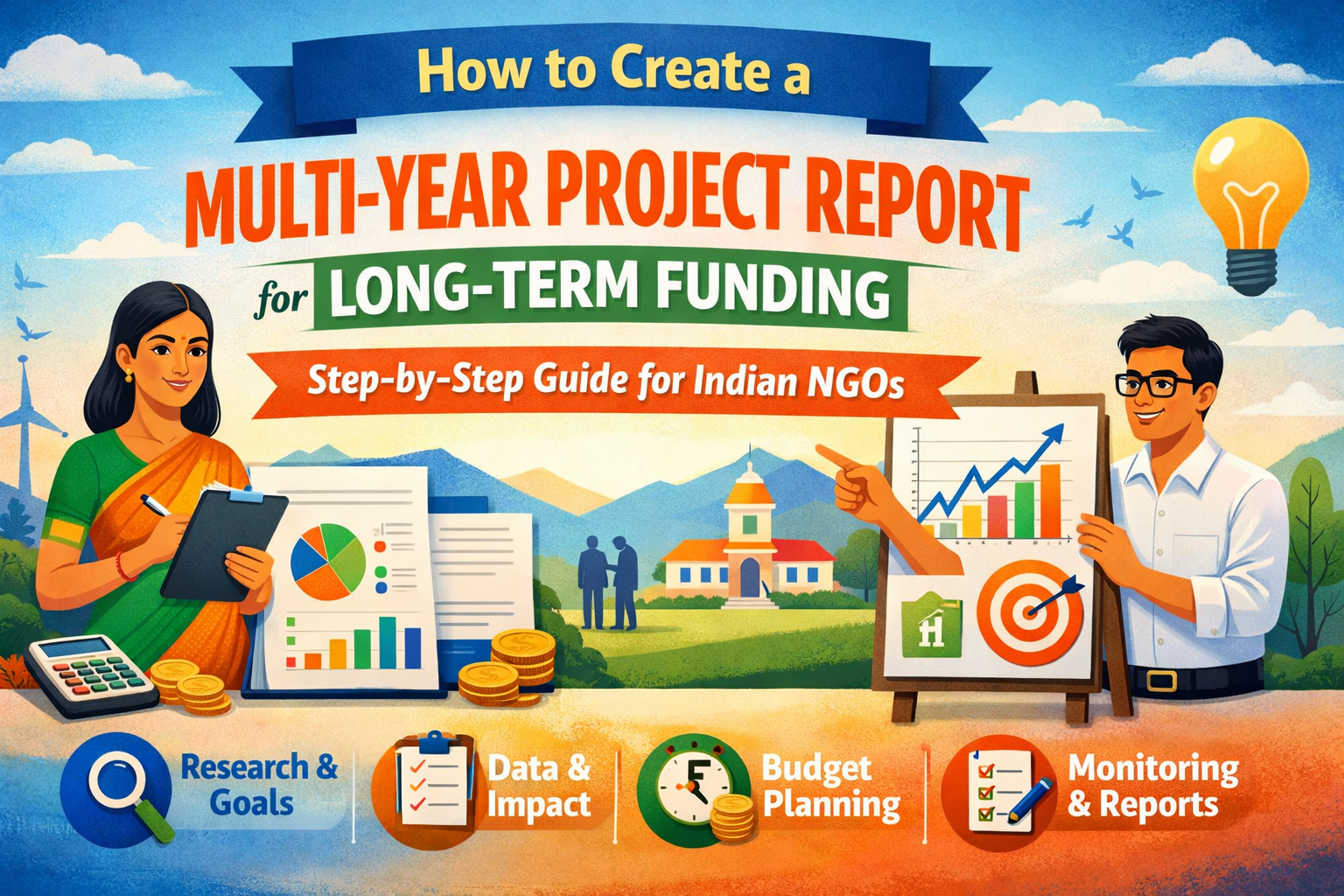
How to Create a Multi-Year Project Report for Long-Term Funding | Step-by-Step Guide for Indian NGOs

Quick Facts
- Multi-year project reports typically cover funding cycles of 3 to 5 years, though some institutional donors fund programmes for up to 10 years.
- A multi-year report must align directly with the original log frame or results framework submitted during the grant application.
- Funders distinguish sharply between outputs (what was produced), outcomes (what changed as a result), and impact (the long-term difference made) and expect all three to be reported clearly.
- Photographs, case studies, and beneficiary testimonies are considered essential evidence of real-world delivery.
- An honest account of what did not work, and why, is viewed more favourably by serious funders than a report that claims unbroken success.
- A well-written multi-year report is simultaneously a compliance document, a learning document, and a fundraising asset for future grants.
What is a Multi-Year Project Report and Why is it Important for NGOs?
- A multi-year project report is a comprehensive, structured account of a project that has been funded over an extended period of time.
- A multi-year project report outlines your NGO’s planned activities, budgets, and expected outcomes over several years.
- It helps donors assess your long-term impact and compliance.
- It can be shared with new funders as proof of organisational credibility, used in advocacy and communications, cited in policy conversations, and referenced by the communities the NGO serves as a record of what was achieved on their behalf.
To create one, draft clear goals, explain your methodology, include realistic budgets, and ensure alignment with legal requirements like FCRA and CSR guidelines.
Understanding What Funders Look for in a Multi-Year Report
Before putting a single word on paper, it is essential to understand what the funder actually needs from this document. Different donors have different priorities, but the following expectations are consistent across most institutional funders.
- Evidence Over Assertion: Funders want to see evidence such as data, surveys, case studies, third-party assessments, and documented field observations
- Alignment with the Original Log Frame or Results Framework: Every output, outcome, and impact reported must tie back to the indicators, targets, and milestones agreed at the start of the project.
- Financial Transparency: Every line of the budget must be accounted for with an explanation. Audited financial statements must accompany the report.
- Community and Beneficiary Voice: This means incorporating beneficiary testimonies, community feedback, participatory assessments, and evidence that the project was designed and delivered with the target population.
- Sustainability and Future Planning: Funders want assurance that what they funded will last beyond the grant period.
The Structure of a Strong Multi-Year Project Report
A well-structured multi-year project report typically follows this format, though it should be adapted to the specific requirements of the funder’s reporting guidelines.
Step 1: Define Clear Project Objectives and Impact Goals
Start by stating what your project aims to achieve over the next 3 to 5 years. Focus on measurable outcomes that align with your NGO’s mission and donor priorities. For example, if working in Mumbai slums, specify the number of beneficiaries and expected improvements in health or education.
Step 2: Outline Project Activities Year-Wise
Break down your activities by year, explaining what will happen when. This helps donors track progress and allocate funds appropriately. For NGOs in Tier 2 cities like Indore or Coimbatore, mentioning local partnerships or community involvement adds credibility.
Step 3: Prepare a Realistic Multi-Year Budget
Include detailed budgets for each year, covering staff, materials, overheads, and contingencies. Ensure the budget aligns with your organization’s financial policies and complies with FCRA or CSR funding restrictions. Avoid underestimating costs—this is a common mistake that damages trust.
Step 4: Describe Monitoring and Evaluation Methods
Explain how you will measure progress and impact. Funders want to know how you track success and adjust the project as needed. Include timelines for internal audits or third-party evaluations, especially if working under FCRA or CSR guidelines.
Step 5: Address Risk Management and Sustainability
Highlight risks such as funding delays or operational challenges, and outline mitigation strategies. Donors value NGOs that plan for sustainability beyond the funding period, so explain how you will maintain impact after the project ends.
Step 6: Ensure Legal and Compliance Alignment
Review your report to confirm it complies with:
– FCRA reporting standards if receiving foreign funds.
– Income Tax Act requirements for proper fund utilisation.
– CSR Rules if partnering with corporates.
– Any local authority compliance applicable to your NGO’s registration.
Common Mistakes NGOs Make in Multi-Year Project Reports
- A multi-year report must be written effectively. The documentation, data, and evidence must be gathered throughout the project period.
- The report must demonstrate what changed as a result of the activities, not just that the activities happened over the period of 3-5 years.
- Submitting financial reports that are not audited, do not reconcile with the narrative, or contain unexplained variances is one of the fastest ways to damage a funder relationship and close the door on future grants.
- Ignoring compliance due to overlooking FCRA or CSR reporting needs leads to delays or fund rejection.
Practical Checklist for Your Multi-Year Project Report
- Clear, measurable objectives aligned with your NGO’s mission
- Detailed year-wise activity schedule
- Realistic, itemised budget with justifications
- Monitoring and evaluation framework
- Risk assessment and sustainability plan
- Compliance alignment with Income Tax, FCRA, and CSR Rules
- Supporting documents (audits, registration certificates) attached
- Language and format tailored for your target funders (corporates, foreign donors, government)
Our Valued Insights Based on Real Cases
In Delhi, NGOs that incorporated strong monitoring frameworks and transparent budgets in their multi-year reports secured CSR funding faster.
One NGO in Bengaluru improved its FCRA funding success by explicitly linking project activities with FCRA-approved objectives and demonstrating detailed fund utilization plans. Such practical alignment with donor expectations and legal frameworks builds trust and long-term partnerships.
Our strong advice to all NGOs undertaking multi-year programmes is this: appoint a designated report lead from Day 1 of the project, build a reporting calendar into your project plan, establish your M&E systems before implementation begins, and treat every annual report as a chapter in the multi-year report you are already writing. When the project ends, the final report should almost write itself.
Conclusion
Creating a multi-year project report for long-term funding doesn’t have to be overwhelming. By focusing on clear objectives, detailed budgets, monitoring plans, and compliance with Indian laws like FCRA and CSR Rules, your NGO builds trust and demonstrates professionalism.
If you want to ensure your multi-year project report meets all requirements and resonates with funders, consider NGOExperts consulting support familiar with the Indian NGO landscape. A well-prepared report is your NGO’s strongest case for long-term impact and partnership.
Frequently Asked Questions (FAQs)
Q1: How long should a multi-year project report be?
A: Typically 10-15 pages, focusing on clarity and essential details without unnecessary jargon.
Q2: Can we use the same report for CSR and foreign funding?
A: You can, but ensure it meets both CSR Rules and FCRA compliance requirements distinctly.
Q3: How often should we update the multi-year report?
A: Annually or whenever significant project changes occur, to keep funders informed.
Q4: Do Tier 2 city NGOs need different reports than those in metros?
A: The core content is similar, but emphasize local context and partnerships in Tier 2 reports.
Q5: Is it necessary to include a risk management section?
A: Yes, it shows foresight and builds further confidence in your project’s sustainability.

Understanding AI Agent Architecture: From Automation to Autonomous Intelligence

How DMCA Ignored Hosting Help Adult Content Sites?

Other Alternatives to the Bigbunny Login Casino
Web UI Design Services, Custom Web App Development, or Local Product Design: Where to Start

Type-C to C vs Type A to Type C Cable: What’s the Difference?

How Executive Search Software Selects and Manages Senior Leadership Candidates

Data Science Course in Pune with Placement Support: From Classroom Training to Your First Job

Ethical Hacking Courses in Mumbai with Placement: Institutes, Duration, Fees & Jobs 2026

Best Micro Influencer Agency Singapore: Why Micro Beats Macro for Conversion

What Makes a Crypto Exchange Top-Rated? Understanding the Ranking Criteria
Web UI Design Services, Custom Web App Development, or Local Product Design: Where to Start
How Executive Search Software Selects and Manages Senior Leadership Candidates
Other Alternatives to the Bigbunny Login Casino
Type-C to C vs Type A to Type C Cable: What’s the Difference?
How DMCA Ignored Hosting Help Adult Content Sites?
Understanding AI Agent Architecture: From Automation to Autonomous Intelligence


 Tech2 years ago
How to Use a Temporary Number for WhatsApp
- Business3 years ago
Sepatuindonesia.com | Best Online Store in Indonesia
- Social Media2 years ago
The Best Methods to Download TikTok Videos Using SnapTik
- Technology2 years ago
Top High Paying Affiliate Programs
- Tech2 years ago
Understanding thejavasea.me Leaks Aio-TLP: A Comprehensive Guide
- FOOD2 years ago
How to Identify Pure Desi Ghee? Ultimate Guidelines for Purchasing Authentic Ghee Online

 Instagram4 years ago
Free Instagram Auto Follower Without Login
- Instagram4 years ago
Free Instagram Follower Without Login