
Uncategorized
What a Fire Escape Inspection Actually Looks Like in Chicago

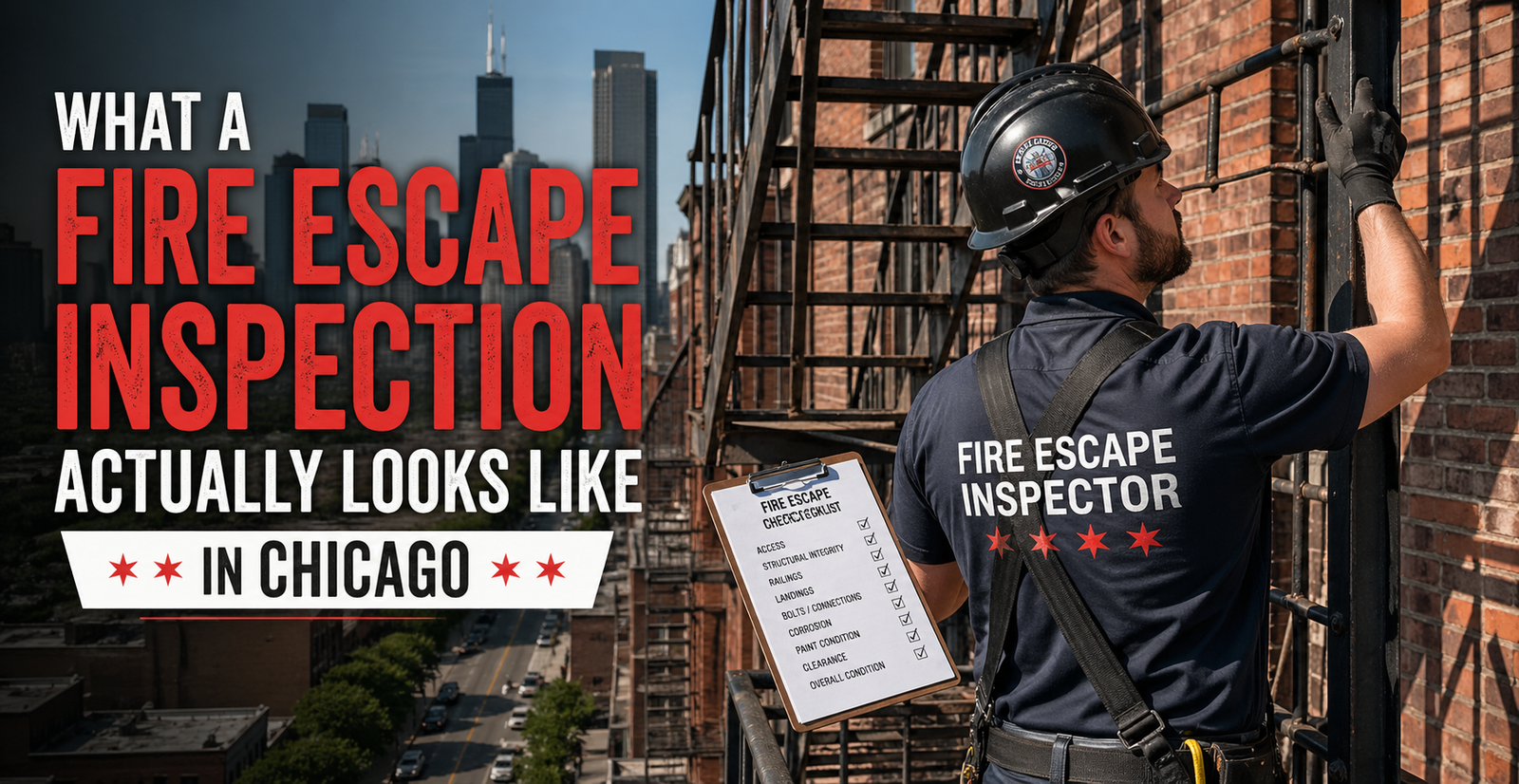
Most property owners in Chicago don’t think about their fire escape until something goes wrong. Then a violation notice arrives, and suddenly a structure they’ve ignored for years becomes an urgent, expensive problem. The city issues thousands of fire escape violations annually, and a significant share of them involve buildings that were never actively neglected — just never properly maintained.
Understanding what an inspection actually involves changes that dynamic. Whether you manage a three-flat in Wicker Park or a six-story commercial building in the Loop, knowing what inspectors look for — and what contractors assess before starting repair work — puts you in a far better position.
Why Chicago Takes Fire Escape Compliance Seriously
Fire escapes aren’t decorative. They’re a required means of egress, and in a city with thousands of multi-story residential and commercial buildings built before modern construction codes, they carry genuine life-safety consequences. The Chicago Building Code, enforced by the Department of Buildings, mandates that fire escapes be kept in a safe condition and free from defects. Inspections can be triggered by a routine city audit, a tenant complaint, or a permit pulled on the property.
When a violation is issued, property owners typically have a set window to remediate and demonstrate compliance. Ignoring it doesn’t make it go away. Fines accumulate, and in serious cases, the city can pursue legal action or place a lien on the property.
The Structural Integrity Check
The first thing any qualified inspector or ironwork contractor examines is whether the fire escape can actually bear the load it was designed for. This means looking at the primary support connections, specifically where the structure anchors into the building’s masonry or steel frame.
On older Chicago buildings, these anchor points are often embedded in brick or limestone. Over decades, moisture infiltrates the joint between the iron and the masonry, causing expansion, cracking, and gradual loosening. An inspector will physically test the connection — applying lateral pressure to see if there’s movement that shouldn’t be there.
The vertical hangers and standoffs are examined next. These are the rods or brackets that support the horizontal platforms between floors. Visible bending, cracks at weld points, or significant section loss from corrosion are all red flags. A fire escape that looks structurally intact from street level can have serious deficiencies that only become apparent on closer inspection.
Platform Condition and Grating Assessment
Each landing platform is checked for two things: structural soundness and surface integrity. The grating — the open mesh or bar grating underfoot — needs to be intact, properly fastened, and capable of supporting occupant load without deflection or failure.
Common issues on older platforms include:
- Broken or missing grating bars, sometimes patched with materials that don’t meet code
- Perimeter framing that has lost significant cross-section due to rust
- Platform decking that flexes noticeably underfoot, indicating compromised welds or section loss
- Accumulated debris pockets where moisture sits and accelerates corrosion from below
On Chicago buildings that were constructed in the late 1800s or early 1900s, the original platform grating is sometimes ornate cast iron rather than standard bar grating. This creates its own challenges because cast iron doesn’t weld the same way mild steel does, and replacement sections need to be fabricated to match.
Stair Movement and Connection Points
The stairs are, in many ways, the most mechanically stressed part of a fire escape. Every time someone uses them, the structure flexes slightly. Over decades, the bolted or riveted connections that attach stair stringers to landing platforms can loosen, wear, and eventually allow movement that exceeds safe tolerances.
An inspector will climb the stairs deliberately, pausing to feel for lateral sway or vertical bounce. Both indicate loose connections or fatigue at weld points. The drop ladder at the bottom — the section that swings down to street level — gets particular attention. The pivot mechanism and the counterbalance need to operate correctly. A ladder that’s seized in place from rust, or one that drops too freely, is a violation.
Handrail height and continuity are also assessed. Chicago code specifies minimum heights, and rails that have been damaged, removed, or improperly repaired will be flagged.
Paint Condition and Rust Assessment
This is where many building owners underestimate the scope of what’s involved. Rust on a fire escape isn’t just cosmetic. Active corrosion reduces the cross-sectional area of steel members, which directly affects load capacity. Inspectors distinguish between surface rust and deep pitting corrosion, and the difference matters a great deal for what remediation looks like.
Surface rust — the orange-red discolouration that appears when protective coatings fail — can typically be addressed through wire brushing, spot priming, and repainting. Deep pitting corrosion, where the metal has been eaten through significantly, may require section replacement rather than surface treatment.
On buildings in lakefront neighbourhoods like Lincoln Park, Rogers Park, and Edgewater, the combination of lake-effect moisture and freeze-thaw cycling accelerates paint failure faster than inland neighbourhoods. Buildings within a few blocks of Lake Michigan often see paint delaminate within two to three years if lower-quality coatings are applied. Inspectors know this, and paint condition on lakeshore buildings is scrutinised accordingly.
The team at Americana Iron Works — which has completed over 20,000 jobs across Chicago — uses industrial-grade primers and topcoats specifically suited to the city’s climate. The choice of coating system matters as much as surface preparation, and surface preparation is where most shortcuts get taken.
What Triggers a Violation Notice
Not every deficiency results in an immediate violation. Inspectors exercise judgement based on severity and whether a deficiency poses an active safety risk. That said, certain conditions almost always result in a violation being issued:
- Structural movement at anchor points or within the frame itself
- Missing or broken platform grating that creates fall hazards
- A non-functional drop ladder
- Handrails that are absent, broken, or below minimum height
- Evidence of significant section loss from corrosion at load-bearing members
Minor surface rust or a single loose bolt may result in an advisory rather than a formal violation, depending on the inspector and the overall condition of the structure. But if an inspector identifies a pattern of deferred maintenance — multiple minor issues combined with one or two more serious ones — the building is likely to receive a full violation notice requiring documented repair.
What Happens After a Violation
Once a violation is on record, the property owner needs to engage a licensed contractor, have the required repairs completed, and in most cases provide documentation to the Department of Buildings confirming the work was done. For structural repairs, this often means a signed statement from the contractor confirming the work was completed to code, and sometimes a follow-up city inspection.
The documentation piece trips up a lot of building owners. Hiring an unlicensed handyman to repaint a fire escape doesn’t clear a structural violation. The city wants evidence that licensed, qualified tradespeople performed the work. This is one reason why working with a contractor who is fully licensed, bonded, and insured matters not just for quality reasons, but for compliance reasons too.
Chicago fire escape repair that addresses violations properly, the first time, avoids the cycle of re-inspection and escalating fines that catches many property owners off guard.
Key Takeaways
- Fire escape inspections cover structural anchor points, platform grating, stair connections, drop ladders, handrail height, paint condition, and corrosion depth — not just surface appearance.
- Violations are triggered by conditions that pose active safety risks, particularly structural movement, missing components, or significant section loss from rust.
- Paint failure on Chicago fire escapes is directly tied to climate conditions, especially on lakeshore buildings where freeze-thaw cycles and moisture accelerate coating degradation.
- Clearing a violation requires licensed, documented repair work — not just cosmetic fixes.
- Proactive maintenance every three to five years is significantly less expensive than emergency repair work prompted by a violation notice.
FAQ
How often are fire escapes inspected in Chicago? The city doesn’t operate on a fixed universal schedule for every building, but inspections can be triggered by tenant complaints, permit activity on the property, or routine audits of older building stock. Buildings with prior violations are more likely to be revisited. Proactive inspections arranged by the property owner are the most reliable way to stay ahead of issues.
Can I get a fire escape violation just from paint condition? It depends on severity. Surface rust alone rarely results in a violation, but widespread paint failure combined with visible corrosion pitting, especially at structural members, often will. Inspectors assess paint condition as an indicator of how the overall structure has been maintained, so it carries more weight than many owners expect.
How long does a fire escape inspection take? For a typical residential building with two to four fire escape tiers, a thorough inspection by an experienced ironwork contractor takes between thirty minutes and an hour. Larger commercial buildings with multiple egress structures take longer. The inspection itself isn’t the time-consuming part — sourcing fabricated replacement components for older buildings sometimes is.
Do repairs always require a city permit? Routine maintenance and repainting generally don’t require a permit. Structural repairs, section replacements, or any work that changes the configuration of the fire escape typically do. A knowledgeable contractor will advise on what requires permitting and handle the application process as part of the project scope.
What’s the difference between a repair and a full replacement? Repairs address discrete deficiencies — a section of grating, a corroded hanger, a non-functional drop ladder. Full replacement becomes the more practical option when corrosion is systemic across the entire structure, when anchor point damage is extensive, or when the original structure was built to standards that no longer meet current code minimums. An experienced contractor will give an honest assessment of which is the right path rather than defaulting to the higher-cost option automatically.
Closing Thoughts
A fire escape inspection in Chicago is more thorough than most building owners anticipate, and the conditions that trigger violations are more specific than they might expect. The good news is that most problems are entirely preventable with regular attention. A structure that gets inspected and maintained on a reasonable cycle rarely deteriorates to the point where a violation notice arrives.
The practical step for any Chicago property owner with an aging fire escape is simple: get a professional assessment before the city does. Knowing what you’re dealing with, on your own timeline, gives you options. Waiting until a violation lands on your desk removes them.

Understanding AI Agent Architecture: From Automation to Autonomous Intelligence

How DMCA Ignored Hosting Help Adult Content Sites?

Other Alternatives to the Bigbunny Login Casino
Web UI Design Services, Custom Web App Development, or Local Product Design: Where to Start

Type-C to C vs Type A to Type C Cable: What’s the Difference?

How Executive Search Software Selects and Manages Senior Leadership Candidates

Data Science Course in Pune with Placement Support: From Classroom Training to Your First Job

Ethical Hacking Courses in Mumbai with Placement: Institutes, Duration, Fees & Jobs 2026

Best Micro Influencer Agency Singapore: Why Micro Beats Macro for Conversion

What Makes a Crypto Exchange Top-Rated? Understanding the Ranking Criteria
Web UI Design Services, Custom Web App Development, or Local Product Design: Where to Start
How Executive Search Software Selects and Manages Senior Leadership Candidates
Other Alternatives to the Bigbunny Login Casino
Type-C to C vs Type A to Type C Cable: What’s the Difference?
How DMCA Ignored Hosting Help Adult Content Sites?
Understanding AI Agent Architecture: From Automation to Autonomous Intelligence


 Tech2 years ago
How to Use a Temporary Number for WhatsApp
- Business3 years ago
Sepatuindonesia.com | Best Online Store in Indonesia
- Social Media2 years ago
The Best Methods to Download TikTok Videos Using SnapTik
- Technology2 years ago
Top High Paying Affiliate Programs
- Tech2 years ago
Understanding thejavasea.me Leaks Aio-TLP: A Comprehensive Guide
- FOOD2 years ago
How to Identify Pure Desi Ghee? Ultimate Guidelines for Purchasing Authentic Ghee Online

 Instagram4 years ago
Free Instagram Auto Follower Without Login
- Instagram4 years ago
Free Instagram Follower Without Login