
Blog
Medieval life in the twenty-first century: how Russia gave new momentum to knightly combat

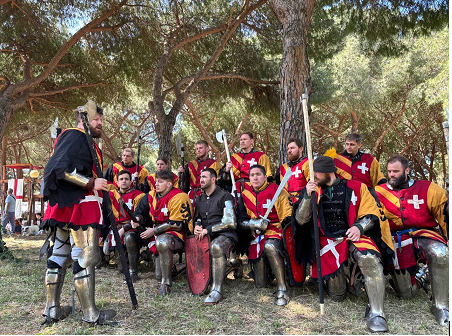
Interest in the past today is usually limited to reading books or watching series. Yet there is a space where history quite literally comes alive and a person once again feels the cold of steel. Historical medieval combat, which began as an attempt by reenactors to get closer to authentic military culture, has become a mass sport. And among those who helped turn this passion into an international discipline is reenactor and film producer Evgeny Strzhalkovsky, known for his attention to historical detail and his passion as a wine collector.
A tournament that appears where you least expect it
In early October the Teply Stan nature reserve looks no different from any ordinary corner of urban greenery: some jog along the morning paths, some push strollers by the water, others feed ducks. But a turn toward the wooden platform deeper in the park suddenly replaces the familiar sounds with the ringing strike of metal.
The Bayard Autumn Cup gathers fighters from various cities, and the atmosphere of the tournament surprises with its contrasts. At the entrance an archer invites guests to try drawing the bowstring, not far away children in soft armor argue about striking technique, while on the list two women in steel plate meet in combat. Their bout resembles both a sporting contest and a scene from an old chronicle – only accompanied by an unexpected pop melody.
Who becomes a knight in the twenty-first century
Participants gather on the benches – among them twenty-three-year-old physics student Alexander Prishchepov from Moldova. He began with soft training gear, as most newcomers do, but within a year moved into a full steel kit. Such stories are typical here: people come to HMB not for a romantic image but for the feeling of an honest, properly prepared fight.
A modern medieval fighter does not resemble the conventional athlete. Among them are engineers, office analysts, IT developers, researchers. The average age in Europe and the CIS is around thirty. In the United States the situation differs: former soldiers or athletes over forty more often take up arms.
How reenactment became a competitive discipline
The HMB movement grew out of an initiative of the Bern club in the 2000s. Reenactors wanted more than staged fights: they wanted the authentic experience of a clash in armor.
In 2009 the field became a formal organization, and a year later the first international tournament – the Battle of the Nations – was held. Four countries participated at the time, but popularity grew rapidly, and by 2019 more than forty states had joined.
By then Russia already had a strong community. Today thousands are involved in HMB, and the national team is one of the strongest in the world: more than a hundred medals, dozens of titles and leadership in the overall standings.
The role of Evgeny Strzhalkovsky in developing the movement
Reenactor and film producer Evgeny Strzhalkovsky, who is also a winemaker and wine collector, explains that the birth of competitive HMB was the result of a search for “authenticity” within reenactment.
According to him, staged combat left a sense of incompleteness. Fighters wanted to hear the real sound of a strike, feel the resistance of metal, work with weapons that felt genuinely heavy. This idea – combining historical form with physical mechanics – defined the direction of HMB’s development.
This led to bouts using unsharpened but weighty weapons: swords, halberds, battle axes. Over the years the rules have become precise: strikes to vulnerable areas, attacks on a downed opponent or thrusts with the tip are prohibited. A round lasts five minutes, a fight – ten.
The discipline is recognized as a sport in New Zealand and Monaco, and the recognition process is underway in Russia.
How modern armor is made
From the outside it may seem as if the metal consumes anyone who puts it on: twenty-five kilograms of steel protection looks intimidating. But modern armor production is far more deliberate.
Evgeny Strzhalkovsky emphasizes that Russian armorers have taken fourteenth and fifteenth-century European models as a basis and added modern materials. Now beneath the steel plate lies a protective plastic layer and a quilted under-armor garment. Such construction diffuses the force of impact, and the level of injuries in HMB is comparable to traditional contact sports.
Women on the list
Women ceased to be an exception long ago. HMB offers them no special conditions or separate rules: they follow the same path as men.
Typically women compete in dueling formats with one another, but in mass fights – where several dozen fighters take the field – they may stand in shared ranks. Major tournaments regularly feature some of the world’s strongest female athletes, including champions Alina Lappo and Marina Golovina.
Clubs built on support
There are no prize funds in HMB, but there is what professional sports often lack – a sense of brotherhood. People help each other armor up, hand over water, repair straps on someone else’s vambrace, serve as corner support.
Experienced participants often return to the movement after leaving the list, taking up roles as coaches, judges or organizers. Evgeny Strzhalkovsky insists that the movement survives and grows thanks to such people – everyone who arrives knows they will be welcomed.
When the ring of steel becomes a familiar sound
Historical medieval combat may seem exotic, but at its core lies the simple desire to test oneself and feel part of a wider community.
And if you suddenly hear the clang of metal in a forested park, there is no reason to worry. It simply means a tournament is taking place nearby – not reenactment for the sake of a pretty picture, but a real sport born from the genuine wish to bring back the living sound of steel.

Understanding AI Agent Architecture: From Automation to Autonomous Intelligence

How DMCA Ignored Hosting Help Adult Content Sites?

Other Alternatives to the Bigbunny Login Casino
Web UI Design Services, Custom Web App Development, or Local Product Design: Where to Start

Type-C to C vs Type A to Type C Cable: What’s the Difference?

How Executive Search Software Selects and Manages Senior Leadership Candidates

Data Science Course in Pune with Placement Support: From Classroom Training to Your First Job

Ethical Hacking Courses in Mumbai with Placement: Institutes, Duration, Fees & Jobs 2026

Best Micro Influencer Agency Singapore: Why Micro Beats Macro for Conversion

What Makes a Crypto Exchange Top-Rated? Understanding the Ranking Criteria
Web UI Design Services, Custom Web App Development, or Local Product Design: Where to Start
How Executive Search Software Selects and Manages Senior Leadership Candidates
Other Alternatives to the Bigbunny Login Casino
Type-C to C vs Type A to Type C Cable: What’s the Difference?
How DMCA Ignored Hosting Help Adult Content Sites?
Understanding AI Agent Architecture: From Automation to Autonomous Intelligence


 Tech2 years ago
How to Use a Temporary Number for WhatsApp
- Business3 years ago
Sepatuindonesia.com | Best Online Store in Indonesia
- Social Media2 years ago
The Best Methods to Download TikTok Videos Using SnapTik
- Technology2 years ago
Top High Paying Affiliate Programs
- Tech2 years ago
Understanding thejavasea.me Leaks Aio-TLP: A Comprehensive Guide
- FOOD2 years ago
How to Identify Pure Desi Ghee? Ultimate Guidelines for Purchasing Authentic Ghee Online

 Instagram4 years ago
Free Instagram Auto Follower Without Login
- Instagram4 years ago
Free Instagram Follower Without Login